This website is the Republic of Korea government's e-government website

 LOCATION
SAFETY GUIDELINES
-
Shelters near me
-
Surrounding safety facilities
Stage-by-Stage Safety Guidelines
Prepare for Earthquakes in Daily Life
Secure safety in your home.
- Take note of safe evacuation spaces in your home, such as under a table, in advance.
- Check the dangerous locations, such as around glass windows or objects that are prone to falling, and stay away from them when an earthquake occurs.
- Prepare thick indoor shoes to protect your feet from broken glass, etc.
- Carefully handle stoves and other dangerous objects that can cause fire.
Securely fix in position the objects that are prone to falling in your home.
- Securely fix furniture and electronic appliances in position so that they don’t fall during an earthquake.
- Do not place objects that can fall, such as TVs and flower vases, in elevated places.
- Secure the doors of cupboard so that objects inside do not fall out.
- Protect glass windows from damage by attaching films.
Keep your home safe.
- Check gas and electricity in advance.
- Check the building and fences as often as necessary and repair dangerous parts.
- When detecting cracks on the building, consult an expert for repair and reinforcement.
Hold family meetings regularly to prepare for emergency situations.
- Take note of a method to cut off gas and electricity.
- Take note of a space where you can evacuate to, such as a wide area near where you are staying.
- Decide a meeting point and contact method with your family in emergency.
- Familiarize yourself with the method to administer first aid through repetitive training.
Prepare emergency supplies in normal times.
- In preparation for an earthquake, stock up emergency supplies and take note of their storage locations and methods for use.
- Have a fire extinguisher handy and learn the directions for using it as fire can occur during an earthquake.
When an earthquake occurs, evacuate like this.
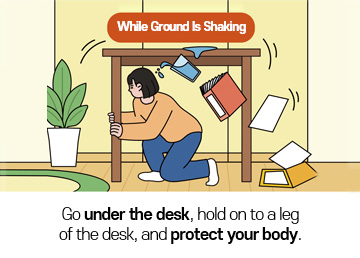
While Ground is Shaking?
- While shaking continues, go under a table to protect your body and hold a leg of the table tightly.
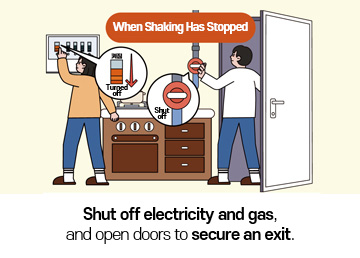
When Shaking Has Stopped?
- When shaking stops, cut off gas and electricity and open doors to secure an exit.
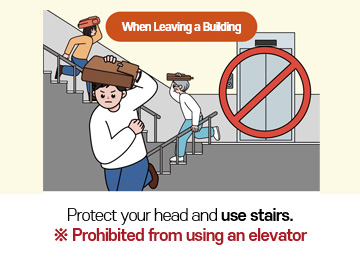
When Leaving a Building?
- When leaving a building, move swiftly through stairs (It is prohibited to use an elevator.)
※ When in an elevator, press the buttons for all floors and get off the elevator on any floor the elevator door opens first.
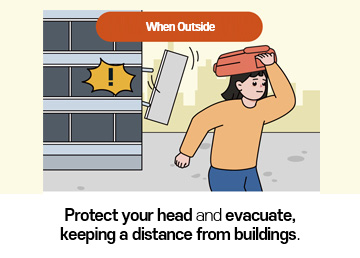
When Outside?
- When outside a building, protect your head using a bag and your hands. While evacuating, keep your eyes on the surroundings and make sure to keep distances from buildings.
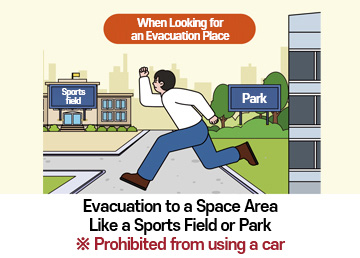
When Looking for an Evacuation Place?
- Evacuate quickly to an open field, a park or any wide space, keeping your eyes on the falling objects (It is prohibited to use a car.).
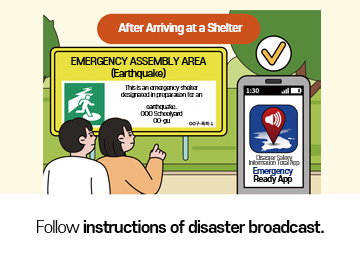
After Arriving at an Evacuation Point?
- Follow correct information provided through the radio or announcements of public organizations.
Safety Guidelines by Location
When at Home
- Go under a table to protect your body.
- When shaking stops, cut off gas and electricity, open doors to secure an exit and go outside.
When Outside
- Protect your head using a bag or your hands in preparation for falling objects. Evacuate to a wide space, such as a sports ground or a park, while keeping a distance from buildings.
When in Elevator
- Press the buttons of all floors and get off the elevator on any floor the elevator door opens first
※ Do not use an elevator during an earthquake.
When at School
- Go under the desk and hold on to a leg of the desk firmly.
- When shaking stops, evacuate to an open field in an orderly manner.
When in Department Store or Supermarket
- Protect your body from objects falling off from showcases, and move to an area near stairs or pillars.
- When shaking stops, evacuate to outside.
When in Theater or Stadium
- Wait until shaking stops, protecting your body using a bag or other personal belongings. Then, evacuate calmly as instructed.
When on Subway
- Hold on to a handle or a pillar to not fall.
- When the train stops, move as instructed.
When Driving
- Turn on the hazard warning lights, lower your speed and pull over on the right side of the road. Then, while listening to the radio for information, evacuate with the car key inserted inside.
When in the Mountain or Sea
- Evacuate to a safe place, watching out for landslides and cliff collapses.
- If you are in a coastal area, move to an elevated place when a tsunami alert is issued.
Safety Guidelines for People with Disabilities
If you have bad eyesight or a visual impairment
- First, get a sense on the situation by listening to the radio or TV.
- If you need to evacuate, move slowly while checking for any obstacles, such as fallen objects, on the ground. Actively seek for help from people around you.
- To prevent secondary damage, request people around you to check for areas with fire, etc.
If you have difficulty moving or a physical disability
- Evacuate with your neighbor, not by yourself.
- If you use a wheelchair or a walker, lock the wheels, bend your body forward and protect your head and neck using a book, pillow, cushion, etc.
- If you cannot move, wait in a relatively safe place until help arrives.
- If you are staying home without moving to an open space or an evacuation point outside, notify it to your neighbor or a government official so that so do not become isolated.
If you have bad hearing or a hearing impairment
- Try to collect information by watching the captioned broadcast on TV or your mobile phone.
- If in a situation where you cannot move, notify where you are by blowing a whistle, etc. for help.
- Inform people around you about your hearing impairment and ask for help to guide you to a safe place.
※ If you have a language disorder, try to collect information about the situation using paper and a pen to communicate.
If you suffer from mental instability or have a developmental disability
- Do not dash out or run out hurriedly.
- Observe what has been decided with your family or people that help you.
- If you cannot make a decision by yourself because of confusion, ask for help to people around you.
Safety Guidelines When with a Child
Use a baby wrap rather than a stroller.
- For infants and toddlers, prepare a baby wrap because it is difficult to use a stroller during evacuation. When evacuating, hold your baby using a wrap carrier to keep your hands free. Protect your baby and yourself with the hands.
For evacuation, hold your child in your arms with shoes on.
- In an earthquake situation, the road becomes dangerous with glass fragments and debris of collapsed buildings. So, even if your child can walk, you should hold the child in your arms when evacuating. When carrying your child on your back, protect the child’s head and, when holding your child in your arms, make sure your child wears shoes.
- Hold your child’s hands tightly and remind the child of the action plan.
- Keep holding each other's hands tightly when evacuating so as not to be separated in the chaotic situation. Even if your child is already aware of the action plan, keep reminding him or her of the details so that you can respond to the situation together.
Safety Guidelines after Shaking Stops or Evacuation
- Check on your family’s situation and if any of your family members has been injured, and ask for rescue immediately.
- When shaking stops, check if any member of your family has been injured and there is any danger in your home.
- If a member of your family has been injured, administer first aid by cooperating with your neighbors and report to an emergency rescue agency, such as a fire station (119).
- Decide whether or not to go home depending on the status of damage in the surrounding areas.
- When an earthquake occurs, follow instructions provided through the radio and by public organizations and decide whether or not to go home based on the information provided.
- After returning home or to your office, check the surroundings, being mindful of safety.
- Check for damage in your home and office and, if safety is in doubt, ask for inspection by experts.
- Be careful when opening the doors of closets, drawers in your office, etc. because the objects inside can fall out.
- Check for accurate information.
- Beware of groundless rumors and follow the earthquake action plans by checking information provided by government organizations or through TV and radio.
Responsible Department:
Earthquake Disaster Management Division (+82-44-205-5192)