This website is the Republic of Korea government's e-government website

 LOCATION
SAFETY GUIDELINES
-
Shelters near me
-
Surrounding safety facilities
Stage-by-Stage Safety Guidelines
Key Safety Guidelines
- Heat wave can cause heat stroke, heat cramp and other illnesses. In a severe case, it can lead to death. In addition, heatwave can cause inconvenience in life due to a rapid increase in power consumption as well as property damage, such as death of livestock and marine products.
Detailed Safety Guidelines
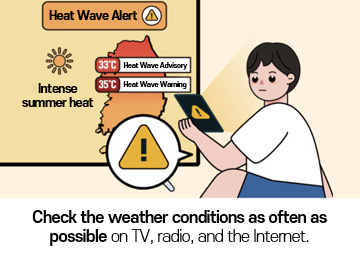
- In summer, keep your eye on the weather conditions and share information with people around you.
- In summer, regularly check heat-related weather updates through TV, radio, the internet, or other media.
- Take note of the symptoms of heat-related illnesses, such as heat stroke, and contact information of nearby hospitals with your family and neighbors and familiarize yourself with the method to handle the illnesses.
- Take note of the contact information of hospitals near your home and check your family and yourself for the symptoms of heat-related illnesses.
- The vulnerable group, such as children, the elderly and patients of cardiovascular and cerebrovascular diseases are more vulnerable to heat, and therefore requires greater attention to healthcare.
- Take note of the symptoms of and handling methods for diseases caused by heat (sweat rash, heat cramp, heat stroke, heat stagnation, burn).
- Check the preparation status of supplies necessary for the hot summer season, and check the information with your family and neighbors.
- Check on air conditioner, fans, etc. in advance to use them in summer.
- Install curtains, pieces of cloth, films, etc. on the windows to block direct sunlight.
- For going out, prepare a wide-brimmed hat, a sunshade and sunblock.
- In preparation for power failure, check if you have flashlights, emergency rations, fans, a portable radio, etc.
- In preparation for water supply disconnection, fill your bathtub with water.
- In old houses, check the transformer in advance to prevent overload.
- Make a decision for long-distance trips carefully as there is a risk of accidents caused by deformation of the roads and railroad tracks.
- Take note of heat-related safety information.
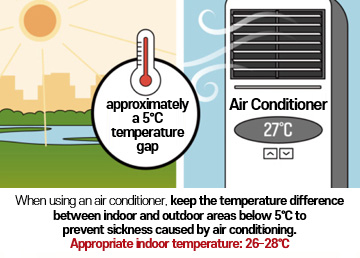
- When using cooling devices, keep the temperature difference between indoor and outdoor spaces as approx. 5℃ to prevent aid conditioning sickness (The ideal indoor cooling temperature is 26℃–28℃.).
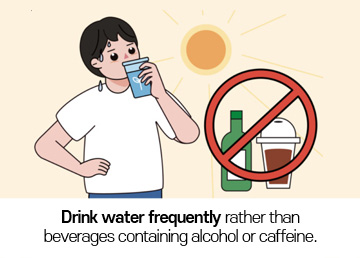
- Refrain from caffeinated or alcoholic beverages, and drink spring water or ionic beverages.
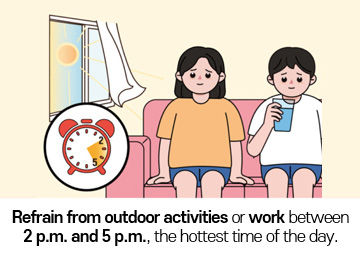
- The hottest time of a day is between 2 p.m. and 5 p.m. During this period, refrain from working outdoors.
- As food spoils easily in summer, do not consume food that has been left outside for long.
- Check on safety of the vulnerable.
- Check the contact information of children, the elderly, etc. in advance and carefully check on the heatwave response status.
Key Safety Guidelines
- When a heatwave is forecast through TV, radio and the internet, refrain from outdoor activities as much as possible and check on the elderly living alone, etc. and others with health issues.
During Heatwave Occurrence
- At home, with your family
- Refrain from outdoor activities. If you have to go out, put on a wide-brimmed hat and light clothing and carry with you a water bottle.
- Drink plenty of water and do not consume caffeinated or alcoholic beverages.
- When indoors without cooling, block out sunlight and ventilate to let in headwind.
- Do not leave children, the elderly, etc. unattended in a car with windows closed.
- When leaving home for a long time with the elderly, the physically weak, patients, etc. experiencing difficulties moving alone at home, ask for help to your relatives and neighbors, and call as often as possible to check on their safety.
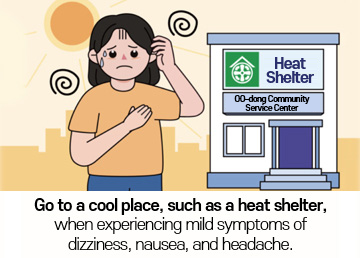
- If experiencing such symptoms as dizziness, nausea, headache and muscle spasm, move to a cool place to take a rest and slowly drink a cold beverage.
- In workplace, with coworkers
- It is better to have short breaks from work frequently rather than one long break.
- Refrain from various outdoor events, such as a sports match.
- Take a nap for 10–15 minutes during the lunch break to keep healthy conditions.
- Put on comfortable clothes to lower your body temperature.
- When indoors with no air conditioning, block sunlight and turn on the fans and open windows and doors for ventilation.
- When working outside, such as at a construction site, follow the safety rules for heat water (water, shade, rest). In particular, implement the heat break system actively between 2 p.m. and 5 p.m., which is the hottest time of a day.
- In school, with students
- If air conditioner or other cooling devices cannot be operated in elementary, middle and high schools, review adjustment of the academic schedule, such as by shortening class hours or closing school, and pay attention to preventing food poisoning.
- When indoors with no air conditioning, block sunlight and turn on the fans and open windows and doors for ventilation.
- Refrain from various outdoor activities, such as physical activities on the sports field and school trip.
- In livestock and aquaculture farms, with local residents
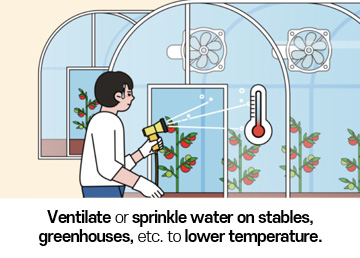
- Open windows of the barn and continuously ventilate the air. Also, keep an appropriate rearing density.
- Install water spraying devices on the ceilings of barns, greenhouses, etc. to lower radiant heat.
- Continuously observe farmed fish and suppress water temperature increase by using ice, etc.
- When the death of livestock or fish occurs, report it immediately to a quarantine agency and follow the instructions given.
- Use of heat shelters
- While you are outside or if there is no cooling device in your home, move to a heat shelter nearby during the hottest time of a day.
- Take note of the locations of heat shelters nearby through the Emergency Ready App or the websites of Si/Gun/Gu offices.
Key Safety Guidelines
- Familiarize yourself with the standards of a heatwave alert and information on diseases, and make preparations for immediate response to the heatwave alert and other emergencies.
Heatwave Alert
Heat disease common sense
Responsible Department:
Climate Disaster Management Division (+82-44-205-6362)
