This website is the Republic of Korea government's e-government website

 LOCATION
SAFETY GUIDELINES
-
Shelters near me
-
Surrounding safety facilities
Action Guidelines
How to Stay Prepared on a Regular Basis
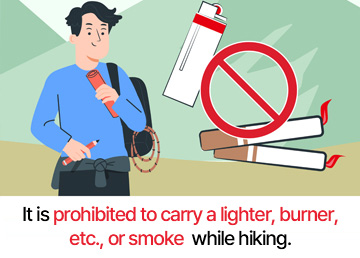
- Prevent forest fire.
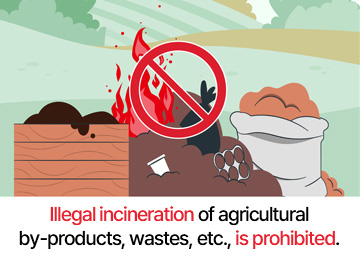
- Do not incinerate waste, agricultural byproducts, etc. near a mountain.
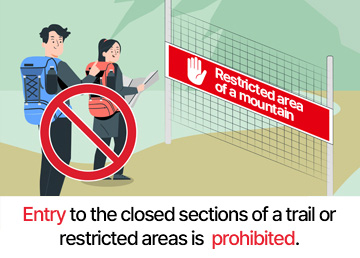
It is extremely dangerous especially on a dry and windy day. - Do not enter the places designated as entry restricted areas or closed sections of hiking trails.
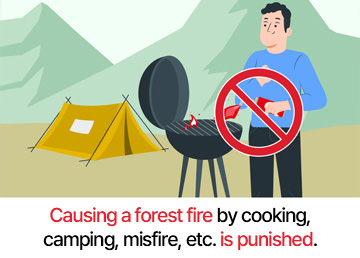
- Cooking and camping are allowed only in the designated areas. After using fire, make sure the fire has been completely extinguished.
- When witnessing smoke or flame in an area near a mountain, report it swiftly.
Report to the fire station (119) and police station (112). - Report to the Disaster and Safety Countermeasures Headquarters of the respective Si/Gun/Gu, Si/Gun/Gu office, Si/Gun/Gu office and administrative welfare center.
Report to the Central Forest Disaster Situation Room, Korea Forest Service (042-481-4119).
Report by using “Report” menu of Smart Forest Disaster app on your smartphone.
- Do not incinerate waste, agricultural byproducts, etc. near a mountain.
- Ensure safety in the areas around your home.
-
- Cover the road surfaces within 1.5m from your home with nonflammable materials, such as stones, sand and earth.
- Near the windows of your home, opt for small plants and succulents rather than large plants and bushes.
- Remove fallen leaves and small branches off of the roof and terraces on a regular basis.
- Store inflammable materials, such as waste, hay and building materials, at least 1.5m away from your home.
- Prepare for an emergency situation with your family.
-
- Set up an emergency contact network and designate individual roles.
- Take note of the evacuation place and route in advance.
※ Evacuation points (shelters) are usually village halls, schools and empty lots away from a mountain. - In preparation for an accident, repetitively training for first aid practice.
- Stock up emergency supplies.
- In preparation for a forest fire, stock up emergency supplies and take note of their storage locations and methods for use.
Emergency Rations: Water, canned food, instant noodle and other items that can be eaten without heating
First Aid Kit: Ointment, cold medicine, digestive medicine, medication you are on, etc.
Household Items: Clothes, toilet paper, wet wipes, lighter, feminine hygiene products, plastic bags
Other: Radio, flashlights and batteries, mobile phone, portable charger, emergency fund, emergency contact information, etc.
- In preparation for a forest fire, stock up emergency supplies and take note of their storage locations and methods for use.
02. When Forest Fire Occurs.
- Prepare for a forest fire at home.
-
- Listen attentively for the evacuation notice, and contact your neighbors as often as necessary.
- Prepare emergency supplies and a bag for going outside so that you can leave home immediately.
- Take note of the best evacuation place and route along with emergency response plans of the region.
- Close all doors and windows.
- Remove curtains and move flammable furniture to the middle of a room away from windows and doors.
- Cut off gas and turn on lights so that firefighters can find your home in smoke and darkness.
- Prepare for a forest fire outside your home.
-
- Move flammable materials as far away as possible from your home.
- Sprinkle a sufficient amount of water around your house to prevent the occurrence of a fire from the scattered embers.
- Do not let water flow out from sprinklers and hoses around your home.
※ This can affect the pressure of firefighting water used in forest fire suppression. - Turn on lightings outside of your house so that firefighters can find your home in smoke and darkness.
- In preparation for a case where you need to use your car, move the car near a driveway and take the key with you.
※ Take note of patrol stations along your evacuation route in preparation for a case where you need to refuel your car. - Check if your neighbors are preparing for evacuation.
- If You Have Livestock or Companion Animal
- Move inflammable materials away from a barn and sprinkle a sufficient amount of water.
- In preparation for a case where you have to evacuate with your animals left behind, stock up sufficient amounts of feed and water.
- In preparation for a case where the forest fire spreads while you are evacuating, leave the barn door open and loosen the leash on your companion animal.
- Prepare for a forest fire while hiking or camping.
- Check the emergency situation in your area through announcement, mobile phone, etc. and spread the situation to people around you.
- Stop hiking or camping and move to an area far away from a mountain, avoiding the path through which forest fire is spreading.
03. Below are the evacuation methods by location.
- When at home, evacuate like this.
-
- When your local government, etc. recommends evacuation, move to the informed location immediately.
- Check your neighbors and spread the evacuation situation because there may be some residents who have not yet evacuated.
- Follow instructions of the official personnel while evacuating, and check the danger situation focusing on information on the forest fire through disaster information text message, broadcasting, etc.
- When moving to an evacuation point, use a road that is far away from a mountain. Also, evacuate to a safe place, avoiding the path of forest fire spread.
- Even when you have not received an evacuation notice, evacuate immediately to a safe place, such as a village hall or a school, away from a mountain if you smell smoke or feel unsafe.
- While hiking or camping, evacuate like this.
-
- When evacuating while hiking, descend the mountain swiftly, avoiding valleys and along a path lined with broad-leaved trees.
- When evacuating while camping, move swiftly to a safe zone, avoiding the path of forest fire spread through a road that is far away from the mountain.
- If you have not been able to evacuate, turn you back to the wind, remove fallen leaves and branches, get down on your stomach and keep your posture low.
- When with a child, evacuate like this.
- Hold your baby using a wrap carrier to keep your hands free. Protect your baby and yourself with the hands.
- Hold your child’s hand while evacuating so as not to be separated. Also, remind him or her of the details of action plans so that you can respond to the situation together.
- The evacuation methods for the elderly and the disabled, etc. are as follows.
- [Preparation]
Decide a guardian (helper), such as a family member, a relative or a neighbor, who can provide assistance in the event of a forest fire, and a detailed method to ask for help (phone, etc.) in advance.
※ Prepare an emergency contact network that includes contact information of the guardian (helper).
Stock up your medication and prepare the tools that can be of help during evacuation (cane, wheelchair, etc.). - [Role of Guardian (Helper)]
Provide training and education on forest fire action plans on a regular basis to the vulnerable group times.
※ Safety Vulnerable Group: Children, the elderly, the disabled and others who are vulnerable to disasters
Do not act alone and ask for help to your neighbor or the Si/Gun/Gu office or administrative welfare center of your residence.
※ In emergency, call fire station (119) or police station (112) for help. - If you have difficulty moving, wait in a relatively safe place until help arrives.
- If you have a visual impairment, check the situation using radio, TV, etc. and actively seek for help from people around you.
- If you have a hearing impairment, check the situation through the TV, captioned broadcasting and mobile phone. Also, let people around you know of your disability so that they can help you move to a safe place.
- If you suffer from mental instability or have a developmental disability, stay calm and ask for help to your family or people around you.
- [Preparation]
04. After Forest Fire is Extinguished
- Spread the situation, check for the injured and request rescue immediately.
- After evacuating to a safe place, check for any injuries and spread the situation to your family and friends.
- If you are injured, receive first aid with assistance from people around you. Then, report the situation to the fire station (119) or an emergency service agency.
- Decide whether or not to go home depending on the status of damage in the surrounding areas.
-
- Follow instructions of the Si/Gun/Gu office and administrative welfare center in the area of your residence.
- Check if your house has been damaged and decide whether or not to go home after checking for safety on each route.
- After returning home, check if water supply system, electrical facilities, etc. around your home have been damaged befoe using them.
- Carefully check for any hidden embers in the mountain near your home. If you find any, report it immediately.
Department in Charge
Environmental Disaster Response Division (+82-44-205-6171), (+82-44-205-6173)
orest Fire Prevention and Control Division, Korea Forest Service (+82-42-281-4251)
